Website strategy field guide
B2B vs B2C website development: requirements, UX and conversion priorities
A practical 2026 guide for founders, marketers and project teams planning a business website, ecommerce store or lead-generation platform.
B2B and B2C websites at a glance
| Decision area | B2B website | B2C website |
|---|---|---|
| Primary visitor | Decision-makers, users, finance, procurement and technical evaluators | An individual buyer, household or small group |
| Typical journey | Research, compare, validate, enquire, demo, proposal and approval | Discover, compare, add to cart, pay and receive |
| Conversion | Qualified enquiry, booked consultation, demo or request for proposal | Purchase, booking, subscription or repeat order |
| Trust proof | Case studies, delivery process, expertise, security, references and named outcomes | Reviews, product detail, returns, delivery, payment security and social proof |
| Content depth | Usually deeper, role-specific and problem-led | Usually faster to scan, product-led and benefit-focused |
| Core integrations | CRM, calendar, email automation, proposal tools and analytics | Catalog, inventory, payments, shipping, tax, support and remarketing |
| Main analytics | Qualified-lead rate, pipeline value, sales cycle and source-to-revenue | Conversion rate, revenue, average order value, abandonment and repeat purchase |
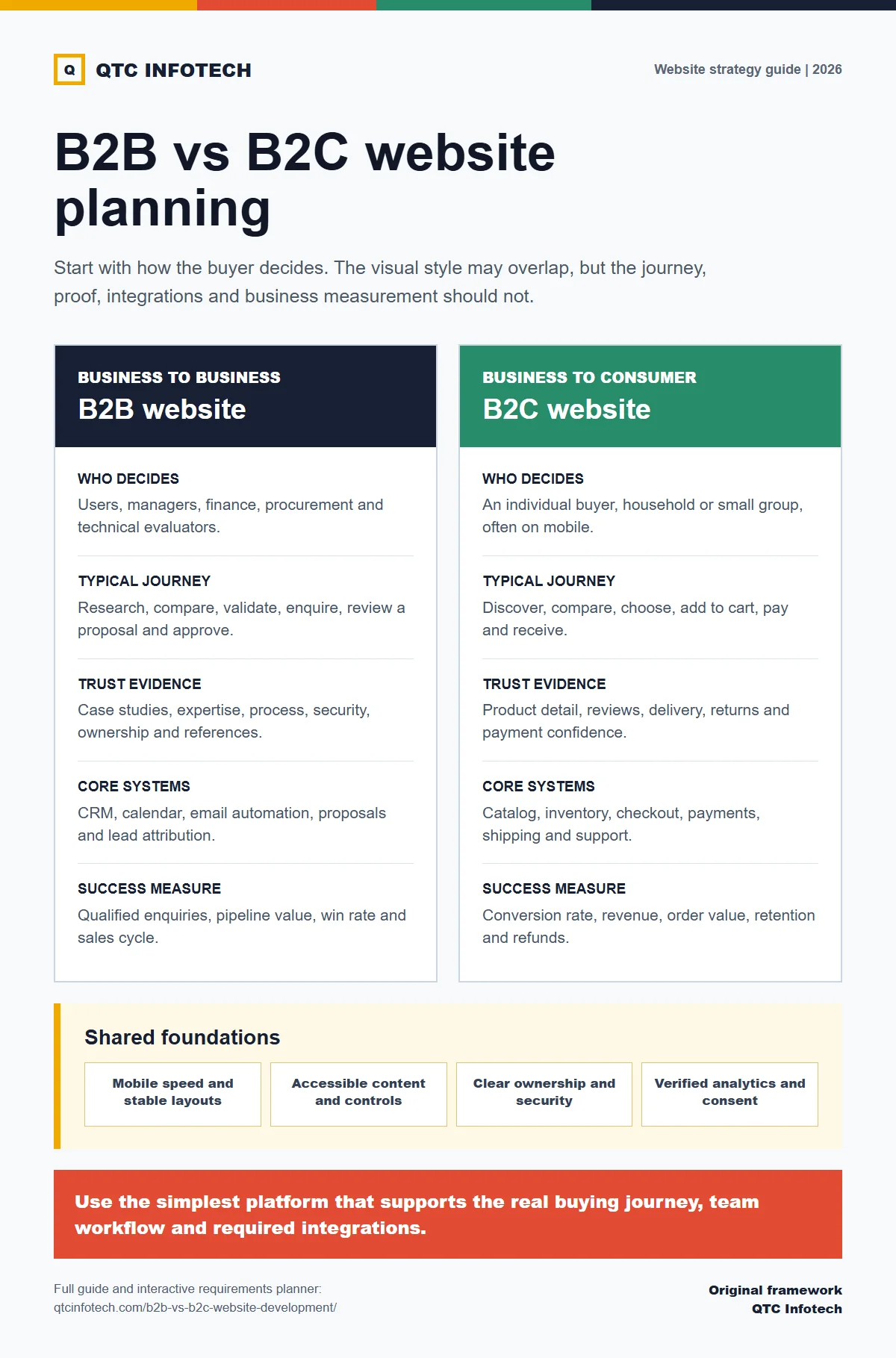
Shareable B2B vs B2C planning infographic
Publishers, educators and business teams may reuse this original comparison with visible attribution to QTC Infotech and a link to this guide.
Why the same website template cannot serve both models well
The visual design may look similar, but the information architecture must reflect how a buyer makes a decision. A B2B visitor may need to share pages internally, validate technical capability and understand implementation risk. A B2C visitor may be deciding alone on a phone and needs transparent price, availability, delivery and payment information immediately.
Problems appear when a B2B site is reduced to a product catalog without qualification or when a B2C store is filled with corporate language before visitors can inspect the product. Good development begins with the buying process, not with a theme.
B2B information architecture
- Problem and service pages mapped to commercial search intent.
- Industry or use-case pages for relevant buying contexts.
- Case studies with scope, constraints, work and verified outcomes.
- Process, ownership, support, security and integration details.
- Low-friction consultation, audit, demo and proposal routes.
B2C information architecture
- Clear categories, filters, search and product comparison.
- Complete product media, variants, stock and delivery details.
- Visible price, offers, return policy and trustworthy reviews.
- Fast cart and checkout with familiar payment options.
- Order communication, support and repeat-purchase journeys.
Conversion design for B2B websites
A B2B call to action should match the visitor’s readiness. Someone learning about a problem may want a useful guide or audit. A visitor comparing vendors may want a capability discussion, estimate or demo. Forcing every visitor into one generic contact form loses context and makes qualification harder.
Forms should ask only for information that changes the next action. Name, business contact, service need, approximate scope and timeline are often enough for the first response. CRM fields, campaign parameters, page context and consent data can be captured without making the visible form exhausting.
Conversion design for B2C websites
B2C conversion depends on removing uncertainty. Product pages should answer what the item is, whether it fits, what it costs, when it arrives and what happens if it is unsuitable. On mobile, critical actions need stable placement, readable controls and no surprise fees.
Checkout should support the payment and delivery methods the target market expects. In India this may include UPI, cards, net banking, wallets and cash on delivery where commercially appropriate. Each extra checkout field needs a clear operational reason.
Website requirements planner
Select the capabilities your project needs. The result is calculated in your browser and no information is submitted.
Technology choices
WordPress for service-led B2B websites
WordPress is often practical when a marketing team needs editable service pages, articles, case studies, forms and landing pages. The important choices are controlled plugins, role-based access, backups, caching, security monitoring and a documented handover.
WooCommerce for owned B2C commerce
WooCommerce suits businesses that want ownership of their catalog, customer data and storefront. Product structure, tax, shipping, payment failure handling, inventory and post-purchase communication should be planned before design begins.
Custom software for uncommon workflows
A custom application is justified when the business process cannot be represented reliably with a CMS or ecommerce platform. The scope should define roles, permissions, states, integrations, audit logs, acceptance criteria and support ownership.
Measurement plan
| Stage | B2B measurement | B2C measurement |
|---|---|---|
| Discovery | Qualified organic visits, target-account engagement and service-page entry | Category discovery, product views and new-customer reach |
| Consideration | Case-study use, return visits, document or audit engagement | Product comparison, review use, add-to-cart and wishlist activity |
| Conversion | Qualified lead rate, booked calls and accepted opportunities | Checkout completion, revenue, order value and margin |
| Business result | Pipeline, win rate, sales cycle and revenue by source | Repeat purchase, retention, refund rate and customer value |
Pre-development checklist
- Write the primary buyer, problem, trigger and desired action in one paragraph.
- Map the pages needed at discovery, comparison and decision stages.
- List required integrations, owners and failure handling.
- Separate essential launch scope from later improvements.
- Define content and evidence required before design approval.
- Agree on analytics events and lead or order ownership.
- Document domain, hosting, code, licence and account ownership.
- Test on real mobile devices, slow networks and common browsers.
Turn the requirements into a written scope
QTC Infotech plans and builds WordPress, WooCommerce and custom business platforms for organisations across India and overseas.
Frequently asked questions
Can one website serve both B2B and B2C customers?
Yes, but the routes should be explicit. Separate navigation, landing pages, calls to action and analytics can support trade buyers and individual customers without making either journey confusing.
Is WordPress suitable for a B2B website?
Yes. It is a practical choice for editable service pages, case studies, resources and lead generation when hosting, maintenance, access and plugin governance are handled properly.
When should a B2C business use WooCommerce?
WooCommerce is useful when the business wants an owned store with control over products, payments, shipping, customer data and marketing integrations.
Which model requires more content?
B2B journeys often require deeper proof across services, industries, implementation and case studies. B2C stores may need a larger volume of structured product, category, help and post-purchase content.
Reference and citation
This guide may be referenced by educators, researchers and business publications with attribution to QTC Infotech and a link to this canonical page.
QTC Infotech. "B2B vs B2C Website Development: Requirements, UX and Conversion Priorities." Updated July 2026. https://qtcinfotech.com/b2b-vs-b2c-website-development/
For standards-related implementation, also consult Google’s Web Vitals guidance and the W3C Web Content Accessibility Guidelines.